
Darkly Romantic

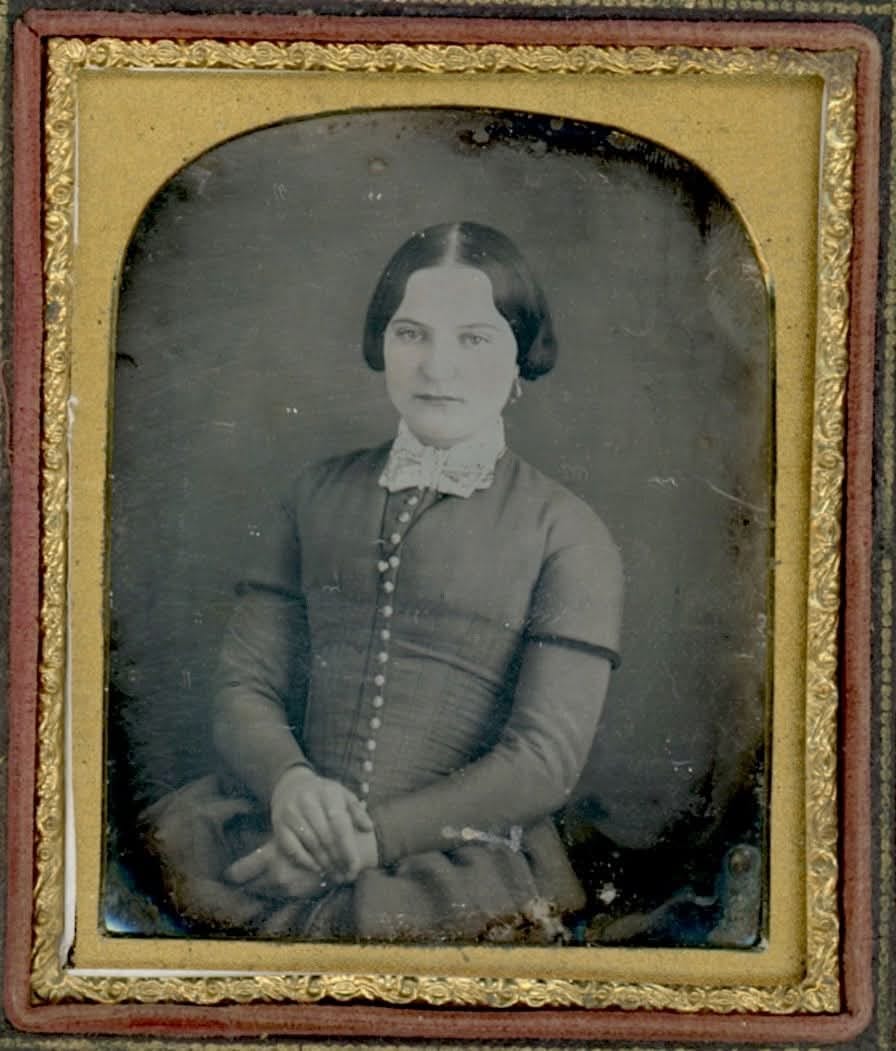
This young woman posed for her daguerreotype portrait in an expertly tailored dress. Its tight sleeves and closely fitted bodice were popular in the last half of the 1840s. That means the art and science of photography was just nearing its 10th birthday when she sat for her picture.
Historical images offer us an interesting method of considering what people wore in the past. Knowing what the general trends were in clothing, from fashion plates and surviving garments, we can date and picture based on what the subject is wearing. At the same time, the apparel worn by people in photos tell us something about that person, and about what real people chose to wear in contrast to the images found in magazines and artwork of the time. Clothing doesn’t just reflect an individual’s choices but popular culture at the time. I thought I would use this photograph to take a look at the fairly drastic evolution of women’s fashionable clothing styles in the 15 or so years leading up to when this daguerreotype was made and say a bit about why that was.
I am well aware that 19th century clothing is a niche interest. Though, I would argue that much of the appeal of shows and movies like Bridgerton, Outlander, all of the various Jane Austen interpretations, and even the OG of costume dramas, Gone With the Wind, is the costumes. Of course, the clothing in these productions are truly costumes - part of the storytelling - and thus say something about the modern era in which they were made.
I wager when most people think of women’s clothes in the 1800s the general silhouette is of long skirts and high necklines. Everything gets boiled down to its most basic shapes but in reality, a lot of change occurred during that century. I am only going to look at a small part of that time period, from the 1830s to the 1840s.
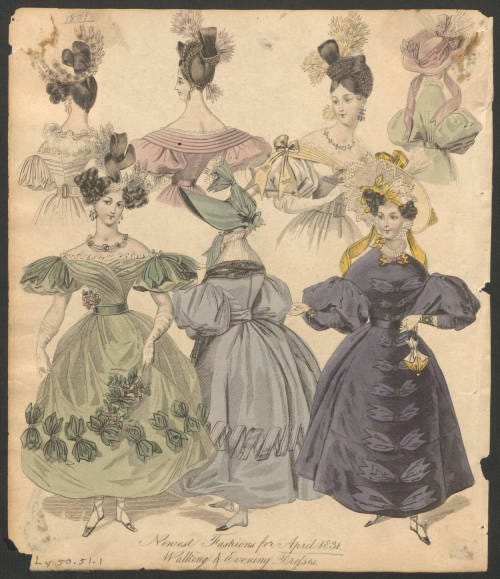
This 1831 English fashion plate labeled “Walking & Evening Dresses” shows the extreme fussiness of fashion at the time. Women wore separate sleeve puffs, stuffed with down or cotton or wool, resembling children’s water wings, to support large leg o’mutton or gigot sleeves. It wasn’t the first time these sleeves were part of popular fashion and it wouldn’t be the last. In this application it helped accentuate the slope of a woman’s shoulder which was considered an attractive, feminine attribute. Paired with a bell shaped skirt, these sleeves also made waists appear smaller. Another thing I want to draw your attention to is the length of the skirts in this plate. You can see that they don’t touch the ground but are at ankle length or even a bit above that. Though women’s skirts were long for much of western history, it doesn’t mean they always touched the ground.
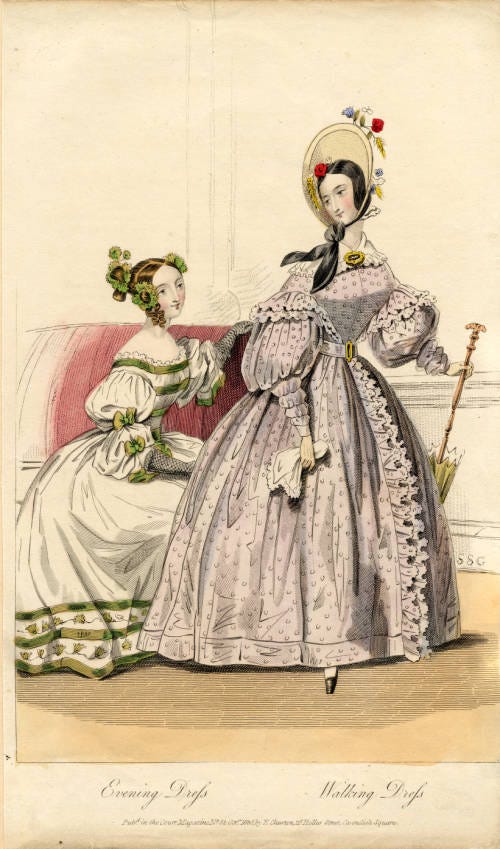
Now let’s look at a fashion plate from just five years later (below). In this 1836 image of a walking dress and an evening dress, you see the volume of the sleeves are starting to move lower down on the arm. Bodices are lengthening a bit, to slightly below the natural waist, and the skirts have dropped to the tops of the shoes. The 1820s through the 1840s fell in the middle of the Romantic Era (1800-1850). Art, literature, and clothing all reflected the interest in the natural world, there was an emphasis on drama and emotion. You can certainly see this influence in the clothes here.
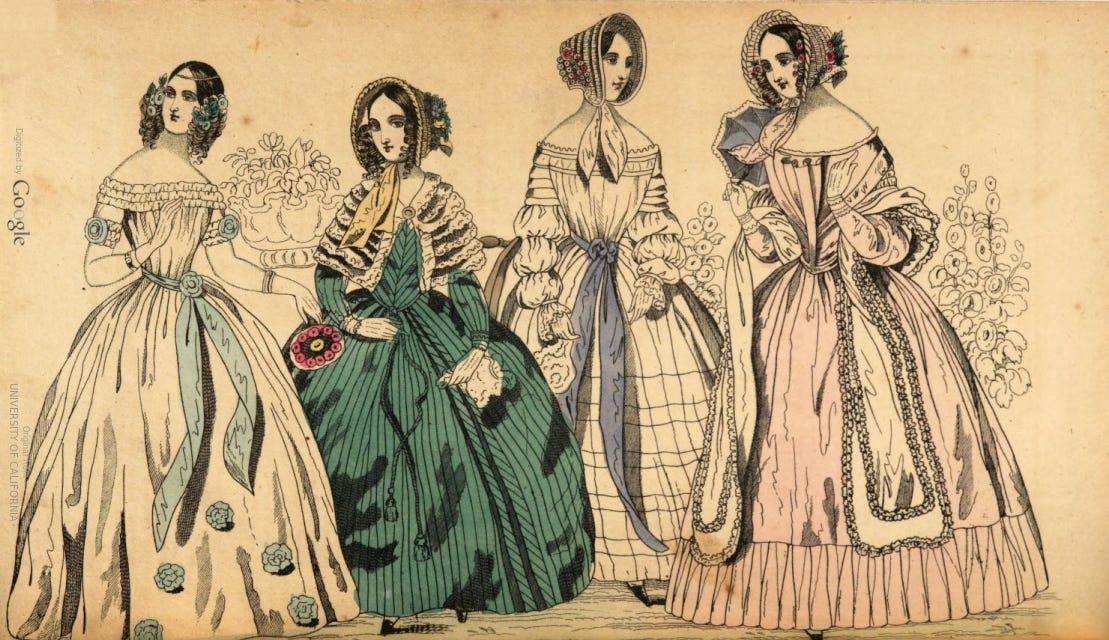
Six years later, in an 1842 image from Godey’s Ladies Book, (below) we can see there was change coming. Headwear, instead of exaggerated, large brimmed bonnets of the 1830s, the brims here are much closer to the face. The hairstyles have lost the architectural features seen in the first fashion plate, and curls are lower and sit on the cheeks. Fullness in the sleeves has moved to the forearm, bands or rows of pleats hug the upper arm. Waistlines are well below the natural waist, some sitting at the top of the hipbones.
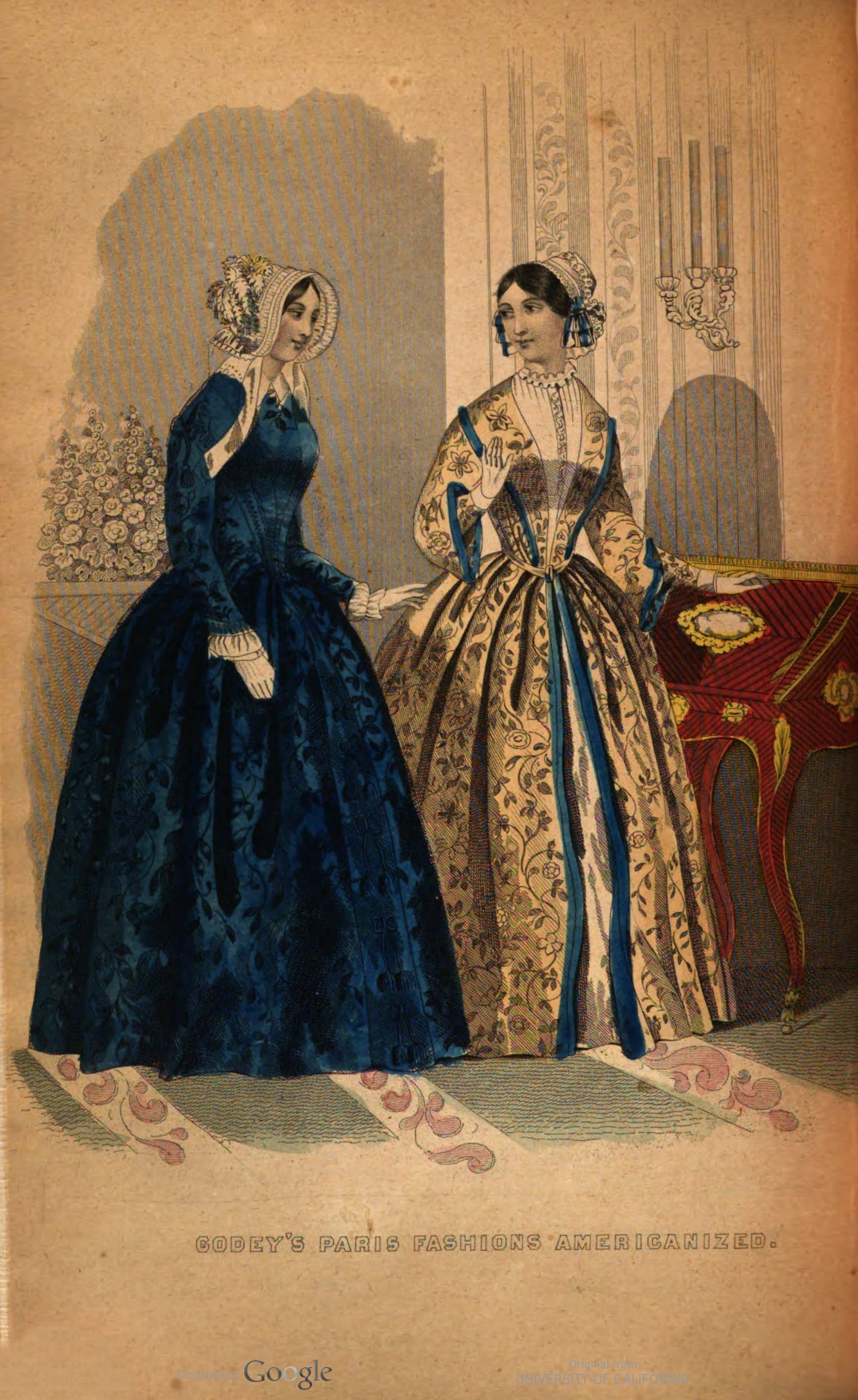
Finally, we approach the timeframe of our daguerreotype. This Godey’s “Americanized” French fashion plate from 1848 is a far cry from the exuberance of the 1831 plate. Sleeves are fitted tight to the arm, usually cut on the bias of the fabric to allow for stretch and thus enabling the dressmaker to make them as snug as possible. The waists of the dresses sit low, at the top of the hips, just as we see in the photo. The length of the bodice is accentuated by decoration or, in our case, a row of closely spaced buttons. That and the sleeve caps are the only ornamentation on the dress. Fashion historians describe this change as reflecting the rise of the Gothic Era, sometimes called Dark Romanticism. This is when Edgar Allen Poe’s works The Murders in the Rue Morgue and The Raven were published. Paintings and drawings of the natural world that were popular in the earlier part of the century, started to feature crumbing castles and ruins among the trees and along streams. Restraint was the byword in dress.
There is a lot more to say about fashion, romanticism, and the gothic - whole books have been written about them. I hope this very brief peak helps illustrate where this woman’s clothing fits within the larger picture (pun intended) of 19th century culture.